The Shift Toward Autonomous Coding: What I'm Seeing in 2026
It has been a while since I last wrote about coding agents. Between the end of 2025 and the first few months of this year, I’ve experienced a fundamental shift in how I work. I wanted to share my thoughts on the trends I’m seeing and highlight key workflow changes that can be massive for those who haven’t fully explored them yet.
1. The “Workflow Over Editing” Threshold
Models have reached a pivotal level of intelligence where autonomous coding is finally in clear sight. For me, the most notable change is their ability to leverage multiple tools effectively. Since the release of Claude 4.5 Opus and the latest GPT series, we’ve passed a critical threshold.
We are seeing much less “inline editing” of snippets and a much heavier focus on workflow optimization. Managing these agents is becoming a new meta-skill in itself.
As Cursor’s blog on the “Third Era” depicts, we are seeing the crossover where agent usage is overtaking simple tab completion. The IDE experience of the future is going to look very different.
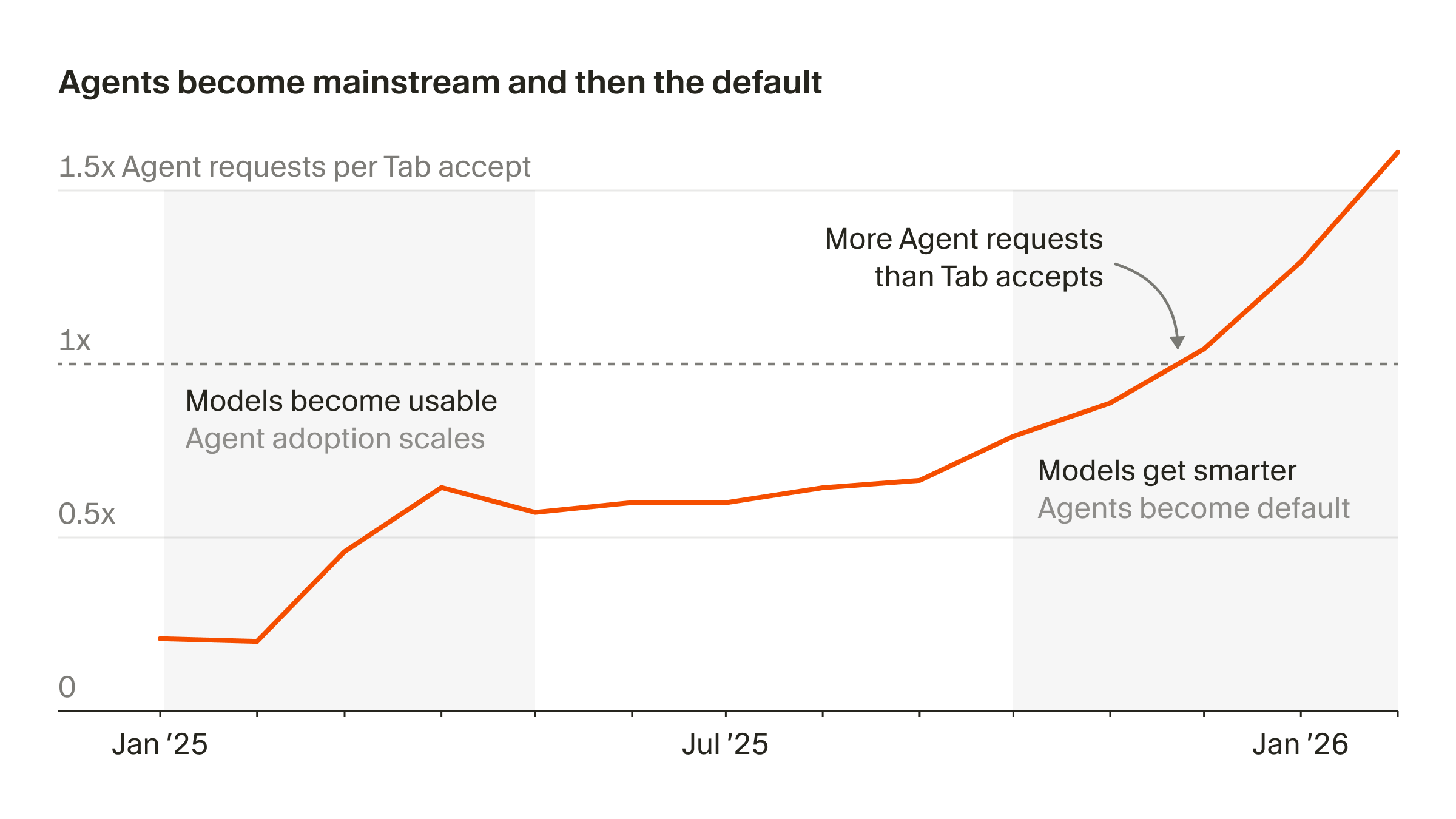 Source: Cursor — The Third Era
2. The Cloud Migration
There is a massive shift toward running agents in the cloud versus locally. While Cursor has had a Cloud agent for a while (followed by Claude Code and others), I have shifted to using cloud agents almost exclusively.
Why it matters: It is non-disruptive. You can run a task anywhere, anytime. It sounds like a small logistical change, but it fundamentally alters development behavior. You don’t just “code at your desk” anymore. If you aren’t exploring this, you’re losing progress that could be made with minimal effort while you’re away from the keyboard.
3. Verification through “Computer Use”
I was incredibly impressed by the recent ability of agents to deploy a feature to a cloud environment and record a demo to play back to the developer.
- Automatic Proof: How many times have we had to manually record a video for verification and also post in a GitHub PR?
- Embedded Testing: The act of the agent “showing” you the work means testing and verification are now baked into the coding workflow.
- Tooling Arsenal: By using Playwright MCPs, I can have agents click through the frontend for me. With more MCPs being supported in cloud environments, agents now have the same “arsenal” I use locally: data validation (Supabase), server logs (Render), and frontend logs (Vercel).
4. The End of “Janitorial” Coding
Cloud automations and scheduled tasks are finally removing the “maintenance tax” from my plate. I’m now offloading things that used to take me several hours a week:
- Cron job fixes
- Data integrity checks and fixes
- Security reviews and report
- Codebase refactor diagnosis
- Documentation updates
5. Scaling Agents and the “Ralph Loop”
Cursor’s research on Scaling Agents—where a team of agents worked independently to build a web browser—highlights a fascinating discovery: we need to organize AI teams to avoid conflicts and blocks, much like structuring a company for self-improvement.
One area people aren’t trying enough is the “Ralph loop”. If you have designed the architecture and logic, but you’re in that tedious final mile of Debug → Fix → Test → Repeat, the agent can take over. You specify the success criteria and a max iteration cap, and it grinds through the cycle for you.
Most common for me is having the agent verify the outcome and if it’s not correct check logs and data, fix and recheck.
6. Where the Gaps Still Exist
While the progress is massive, it’s not perfect. We are currently seeing two main “friction zones”:
-
0 → 1 Development: It’s easy if your bar is low and just want to see what the coding agent can do. However when it comes to production grade need, this remains the toughest. Most of the time, the human is too vague about the end outcome. This is a structural communication gap, not just a technical one.
-
70 → 90 Progression: I recently tested Cursor’s “grind mode” (a long-running agent) on a supplementary feature.
- The Good: It ran for 48 hours and made meaningful progress—about 80% of the way there. It was a memorable experience to see an agent running for two days while I was on vacation.
- The Bad: It spent 50% of that time refactoring code that didn’t need to be touched.
Two questions that came to my mind from initial experience:
- Surfacing Decisions: How can the agent surface “fork-in-the-road” decisions so a human can check in without stopping the momentum?
- Adaptive Planning: How can it expand its plan without going off on a tangent? We are essentially asking it to make a series of judgment calls that align with our intent, even when we weren’t specific enough to begin with.
Conclusion: The New North Star
We are currently witnessing only the earliest tremors of a massive shift in how software is built. As we move from “copilots” to “autonomous agents,” the mental model of a developer has to evolve.
-
The shift is just beginning. We are moving away from being writers of code and toward being architects of workflows. The IDE is no longer just a text editor; it’s becoming a mission control for a fleet of agents.
-
Long-running agents are the next frontier. Expect the quality, duration, and reliability of these sessions to increase rapidly. The “Grind Modes” and autonomous loops that feel experimental today will be the standard operating procedure by next year.
-
The “What” over the “How.” As the “How” (the implementation) becomes faster and cheaper, the competitive advantage shifts to the “What.” The winners will be those who spend less time fighting with syntax and more time thinking deeply about the product, the user experience, and the underlying logic.
Does this mean the future is more whiteboarding?
In a word: Yes. If the “middle” of the development process—the tedious translation of ideas into syntax—is being compressed, we are naturally pushed toward the edges. We’ll spend more time at ideation, architecture, and logic.
The future of “coding” might look less like staring at a blinking cursor and much more like a high-bandwidth session at a whiteboard, defining the constraints and outcomes for an agentic team that is ready to build.